
13 de mayo de 2026.
La Cátedra UNESCO de la Universidad Carlos III de Madrid organiza un seminario sobre Tecnología Educativa en el que participan dos investigadores de reconocido prestigio internacional.
El seminario tiene lugar el 13 de mayo de 2026 a las 11:00 h, en formato híbrido, en la sala 4.1.F03 del campus de Leganés de la Universidad Carlos III de Madrid, y a través de Google Meet haciendo clic en el enlace https://meet.google.com/gfm-vwwr-xgo.
El seminario incluye dos ponencias que se impartirán en inglés.
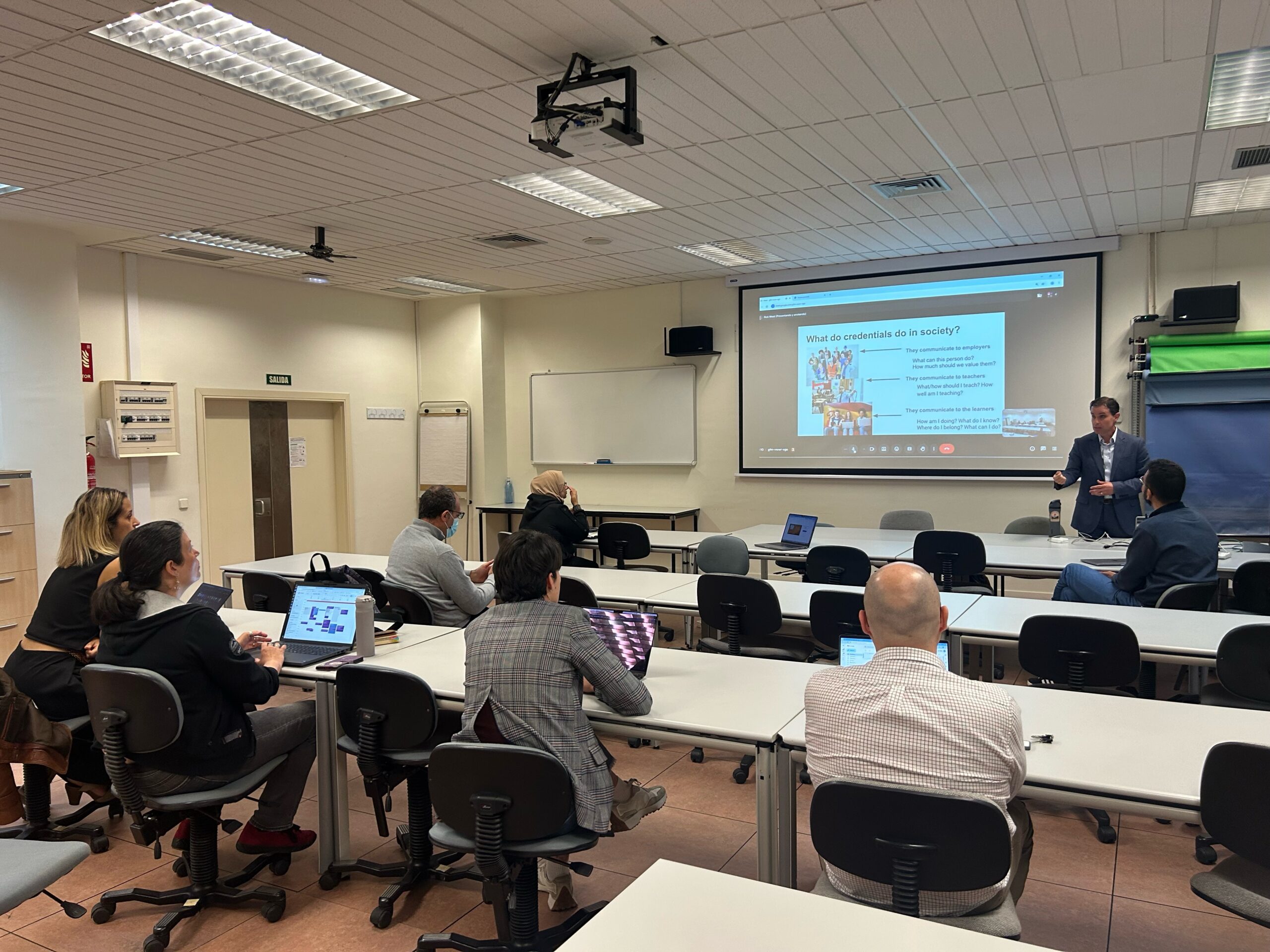
El primer ponente, Prof. Richard (Rick) E. West, del Departamento de Psicología Instruccional y Tecnología de la Brigham Young University (Estados Unidos), comparte sus investigaciones en el ámbito de la tecnología educativa. El Prof. Rick West es actualmente Fulbright Scholar visitante en la Universidad Carlos III de Madrid, y su trabajo abarca el diseño instruccional, las microcredenciales y las insignias digitales abiertas, el aprendizaje en línea y la educación abierta.
Titulo: «How Does This Affect Us? Meso-level Effects of Implementing Open Microcredentials/Badges»
Resumen: «It is now almost 15 years since Mozilla first launched the open badges technology that enabled openly issuing, collecting, and sharing open badges and microcredentials. What have we learned in that time period about the effects of these open credentials? Using the 3M Model, I have been working with colleagues to understand the impacts of these open credentials on learners (micro level), institutions and organizations (meso level), and society (macro level). Most of the research that has been done has been at the micro level of individuals, but we recently completed a systematic literature review analyzing the observed impacts at the meso level. In this presentation, I’ll share the results of our literature review, as well as case studies of how different organizations have used these credentials. I’ll conclude with our findings and suggestions for how organizations can make an open badge/microcredential system more effective.»

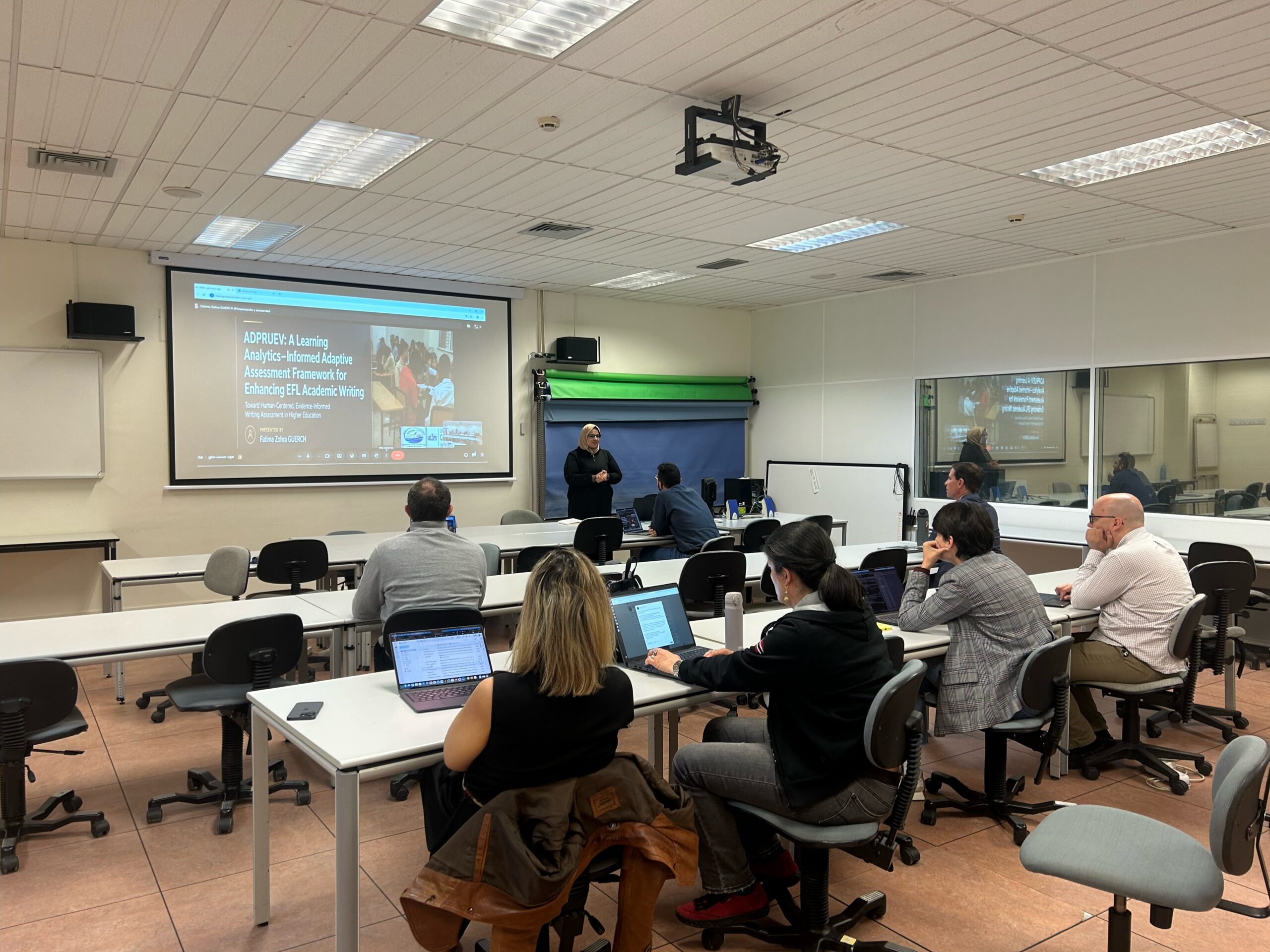
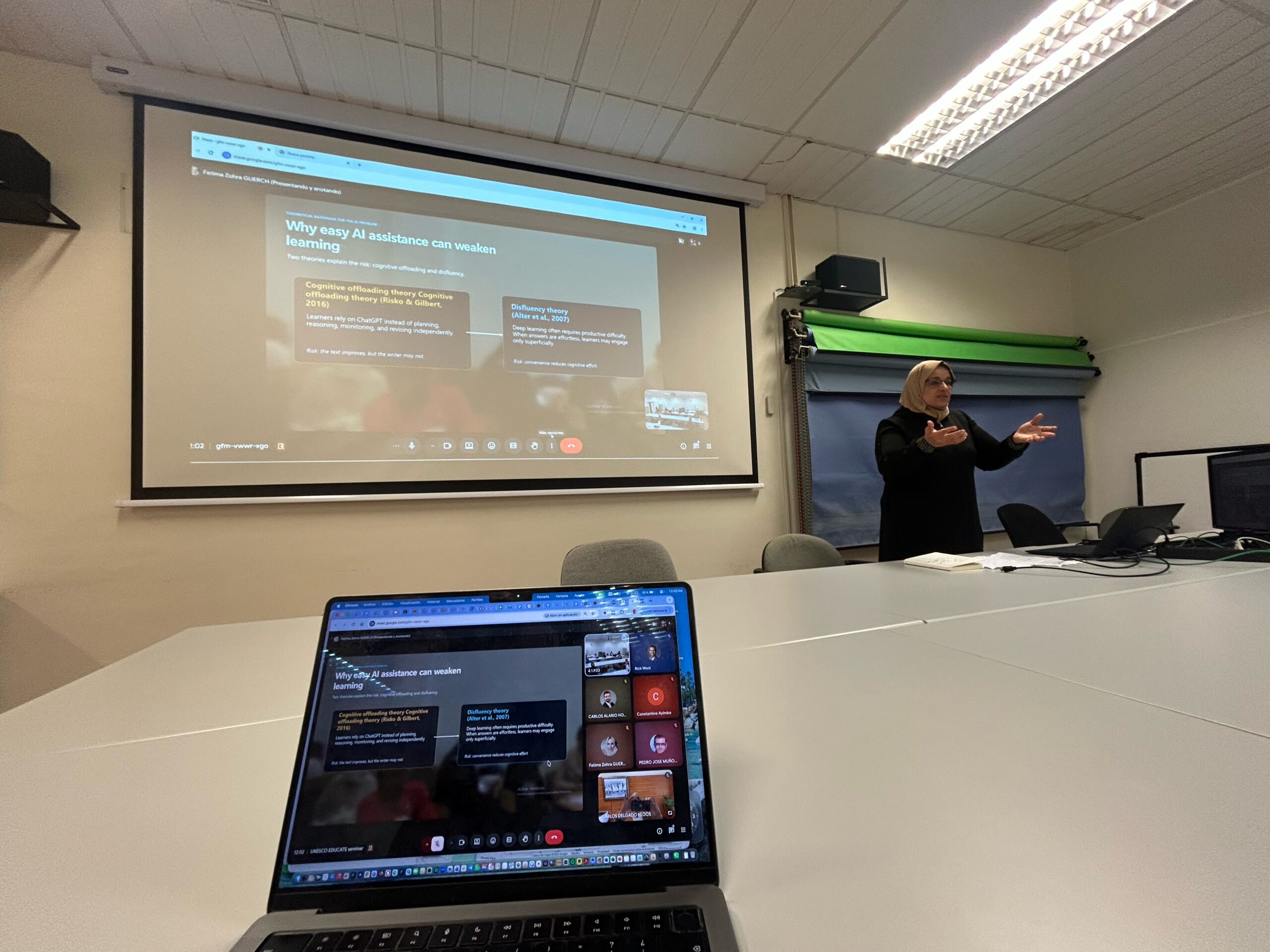
La segunda ponente, Fátima Zohra Guerch, investigadora de la Universidad de Ain Temouchent (Argelia), presenta su trabajo:
Titulo: «A Learning Analytics–Informed Adaptive Assessment Framework for Enhancing EFL Academic Writing in Higher Education»
Resumen: «This study responds to two persistent challenges in contemporary writing pedagogy: the limitations of traditional writing assessment and the growing dependence of learners on generative AI tools. Through integrating Moodle-based learning analytics, analytic writing assessment, textual analysis, help-seeking discourse, and adaptive feedback, this study develops a human-centered blended assessment approach to support the academic writing development of third-year EFL students. The framework is
theoretically grounded in Evidence-Centered Design, analytic writing assessment, second language writing pedagogy, self-regulated learning, feedback literacy, and learning analytics. A quasi-experimental design was employed to compare an experimental group receiving adaptive blended assessment with a control group receiving conventional writing assessment. Data were collected from pre-test and posttest argumentative essays, analytic rubric evaluations, Moodle process indicators, revision evidence, helpseeking messages, a learnergain checklist, and a semi-structured instructor interviews. Writing performance was examined across key academic dimensions, including thesis development, evidence and support, reasoning and development, counterargument and rebuttal, organization and language use. Results indicated statistically significant advantages for the experimental group in overall writing performance, with notable improvement in argumentation, and academic style, strategic revision, feedback interpretation , and self-regulated writing practices. The study contributes to applied linguistics, learning analytics, and technology-enhanced assessment by offering empirically supported evidence for a human-centered blended framework that transforms assessment from a static measurement practice into a dynamic cycle of evidence collection, diagnosis, adaptive feedback, revision, and growth. It demonstrates that learning analytics can improve EFL academic writing when it is embedded in teacher-guided pedagogy, aligned with analytic writing criteria, and used to strengthen, not replace, students’ cognitive and metacognitive engagement.»